Understanding the real-world obstacles that keep operators locked in a cycle of inefficiency, even when they know a better way exists.
In our first article, we defined the “Silent Tax” of fragmented tools, the massive, hidden drain on time, profit, and sanity that plagues small and mid-sized travel operators. The response was clear: for many, it felt like we had put a name to their daily reality.
So, if the problem is so widely recognized, why does the cycle of fragmentation persist? The chasm between recognizing a problem and implementing a solution is wide, and it’s paved with real, justifiable fears.
For most travel businesses, the decision to stick with the chaotic comfort of spreadsheets and disjointed apps isn’t a lack of vision, it’s a rational response to three formidable barriers.
Barrier 1: The Affordability Trap
The first and most obvious hurdle is financial. The market for travel operations software presents a brutal choice: cripplingly expensive enterprise systems or affordable-but-inadequate point solutions.
On one end, comprehensive Enterprise Resource Planning (ERP) systems like Tourplan or Lemax offer deep functionality but at a steep cost. With licensing fees often exceeding $700 per user, per month, plus hefty implementation charges that can reach five figures, they are designed for large-scale operators, not a 10-person DMC. This pricing model instantly places them out of reach for the businesses that form the industry’s backbone.
On the other end, lightweight tools like Travefy or specific CRM platforms seem affordable at $30-$50 per month. However, they solve only one piece of the puzzle. To build a complete operational stack, an agency needs an itinerary builder, a CRM, a accounting tool, and a vendor communication platform. The cost of these “affordable” point solutions quickly stacks up to $100-$200 per month, yet they remain disconnected, perpetuating the very fragmentation problem they were meant to alleviate.
For a small business already operating on thin margins, this is an impossible choice: bankruptcy-level investment or a fragmented patchwork that fails to solve the core problem.
The SMB Software Dilemma: A No-Win Choice?
Loading..........
The Data is Not Available
Barrier 2: The Implementation Fear
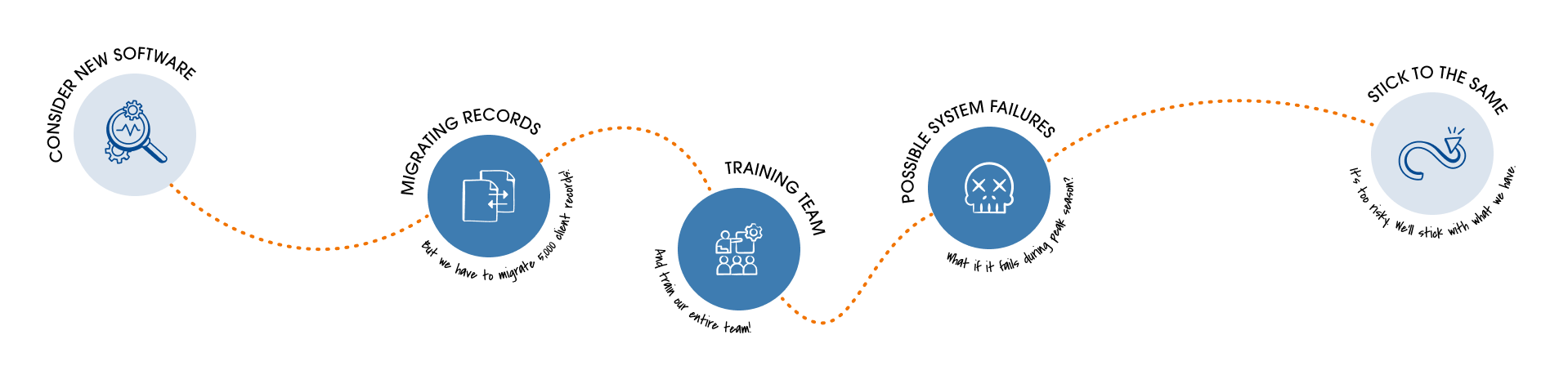
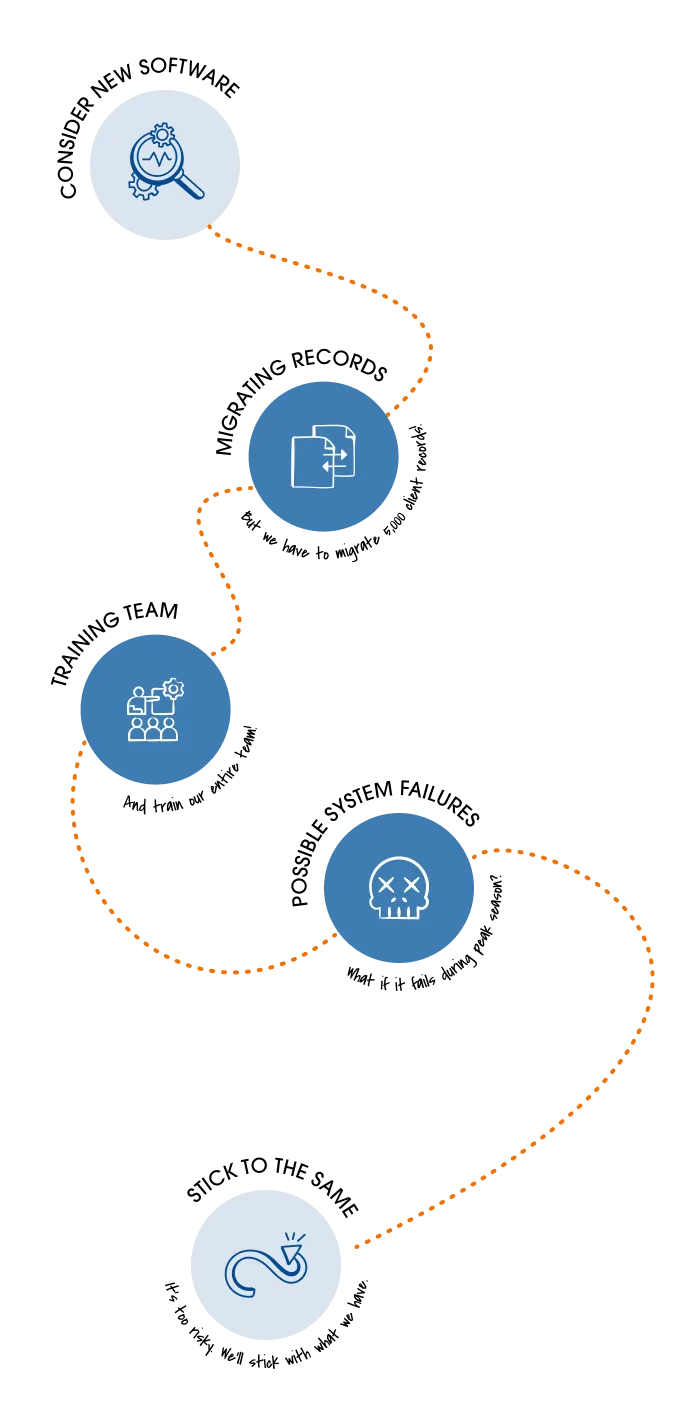
The second barrier is the perceived, and often very real, nightmare of switching systems. The fear isn’t just about the price tag; it’s about the immense operational risk.
The Data Migration Monster
This is the number one fear for any business owner considering a switch. The thought of moving years of valuable data, client profiles, past itineraries, vendor contracts, and financial records, is daunting. The risk of data loss, corruption, or simply the sheer number of hours required for manual validation feels like an existential threat. A report on SaaS adoption highlights that data migration is consistently the single biggest barrier to switching software, as the process is often complex and costly. (1)
The Productivity Dip
Onboarding a new system means a guaranteed period of reduced productivity. Teams need training, and there’s a steep learning curve. For a small, lean team, this temporary dip in efficiency can feel like it could break the business, especially during a peak season. As one analysis noted, the true cost of implementation, including training and lost productivity, can be up to three times the software’s license cost. (2)
Barrier 3: The "If It Ain't Broke" Mindset
The final barrier is the most subtle and powerful: pure behavioral inertia. Human psychology is wired to prefer the known over the unknown, even when the known is painful.
The Devil You Know
Spreadsheets and email chains, while inefficient, are predictable. An owner built these systems and understands their every quirk. A new platform is a black box, an unknown variable that introduces uncertainty.
The Sunk Cost Fallacy
This is the emotional investment in the current "system." The hundreds of hours spent building complex Excel templates and Word documents create a powerful psychological trap. Abandoning them feels like admitting that all that time was wasted, so they continue investing time in a broken system to justify the past investment.
The "Just One More Booking" Fallacy
The mindset of "We'll fix this when we have more time/a bigger team/after the next peak season" is a perpetual cycle. The constant press of daily operations always trumps long-term strategic improvement, and the "Silent Tax" continues to compound, year after year. This inertia is a powerful force; as one analysis of product strategy puts it, customers often don't switch to a better product simply due to the organizational friction involved. (3)
Conclusion: From Barriers to Bridges
These three barriers, The Affordability Trap, The Implementation Fear, and The “If It Ain’t Broke” Mindset, form a powerful trifecta that keeps talented, ambitious travel businesses locked in a state of inefficiency.
Overcoming them isn’t about finding more willpower; it’s about finding a solution that is architected from the ground up to dismantle these specific obstacles. It requires a new approach that bridges the gap between power and simplicity, between cost and value.